

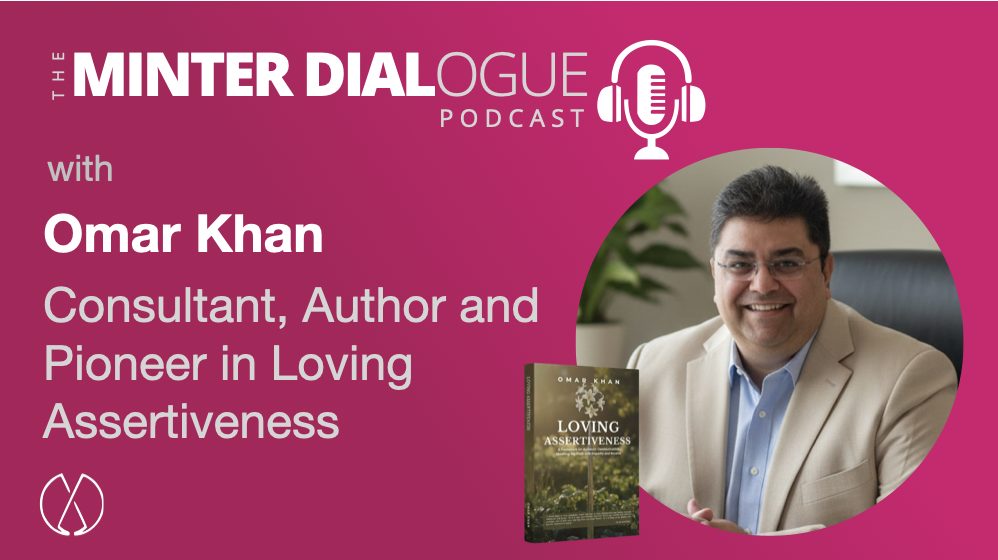
Leadership is often presented as a choice between being tough and being empathetic. Omar Khan believes leaders do not have to choose between the two. In a recent conversation with Minter Dial, the author, executive coach and consultant explored the principles behind his book Loving Assertiveness and explained why effective leadership depends on something more complicated than authority, strategy or expertise.
Khan’s central idea is deceptively simple: leaders can be both compassionate and assertive. In fact, he argues that the combination of love and power, rather than either one on its own, can help organizations have the conversations they need to make meaningful progress. For leaders navigating increasingly complex workplaces, Khan’s approach offers important lessons about communication, conflict, coaching, decision-making, and the changing role of human judgment in an AI-driven world.
What Are Omar Khan’s Leadership Lessons?
Omar Khan believes that strong leadership requires a balance of human connection and constructive challenge. Khan describes this approach as “loving assertiveness,” which encourages leaders to address difficult issues while maintaining empathy and respect for the people involved. Rather than avoiding difficult conversations in the name of harmony, leaders can learn to challenge people directly while strengthening relationships rather than damaging them.
This distinction matters because aggression and passivity can both create problems. Aggressive leadership can damage trust and make people defensive, while passive leadership can allow important problems to continue unchecked. Khan believes there is another option: leaders can communicate firmly, hold people accountable, and still demonstrate genuine care for the people involved.
Loving Assertiveness: Balancing Compassion and Power
Khan describes four possible positions when people deal with conflict. There can be aggression without compassion, passivity without assertiveness, or a combination of passive and aggressive behavior that produces the worst of both worlds. The fourth option is loving assertiveness, which combines power with compassion and allows leaders to challenge others without turning every disagreement into a personal conflict.
One of Khan’s most memorable questions illustrates this principle: “What would you say if you knew it would land well?” The question changes the objective of a difficult conversation because the goal is no longer simply to prove that someone is wrong. Instead, the goal becomes communicating something important in a way that gives the other person the opportunity to understand it and respond constructively.
For leaders, this approach can be particularly valuable. A CEO may need to challenge a senior executive, a manager may need to address poor performance, or a board may need to confront disagreement between executives. Avoiding those conversations does not make the underlying problem disappear, while approaching them aggressively can create an entirely new problem.
One of the Biggest Leadership Problems Is the Conversation Nobody Has
Perhaps one of the most practical insights from Khan’s interview is his distinction between fake conversations and dormant conversations. A fake conversation appears to be about one subject but is actually about something else, while a dormant conversation addresses a real issue without allowing people to say what genuinely needs to be said. Both situations can leave organizations discussing the same problems repeatedly without making meaningful progress.
Khan suggests that recurring problems are one of the clearest warning signs. If the same issue continues to return to the agenda without being resolved, something deeper may be happening beneath the surface. The organization may be discussing symptoms instead of the real issue, or people may be avoiding a conversation because they are concerned about the consequences of speaking openly.
Another warning sign is the familiar phrase, “Let’s take that offline.” There are legitimate reasons to continue a conversation privately, but Khan argues that repeated use of this approach can indicate that important issues are being removed from the collective discussion. Over time, this can create an organization where decisions are officially made by teams but actually negotiated privately between a small number of individuals.
Why Conversations Are Part of the Work
Modern businesses often treat conversations as something that happens around the work. Khan challenges that assumption by arguing that conversations are actually part of the work itself because business performance has a human performance component. Relationships, communication and trust determine whether people can make decisions together and turn those decisions into results.
This becomes particularly important in complex organizations where very few meaningful outcomes are produced by one individual. Projects depend on networks, decisions depend on teams, and strategies depend on people understanding one another and acting together. As Khan explains, no result can be created or sustained that is larger than the relationship on which it is based.
This perspective also changes how leaders should think about time. Executives may spend hours reviewing spreadsheets, presentations, and performance reports while treating conversations as something that must fit around the “real work.” Khan’s approach turns that assumption around: if relationships and communication determine whether decisions are implemented, then improving conversations is not a distraction from performance—it is part of performance.
The Organizational Chart Does Not Tell the Whole Story
Another important lesson from Khan concerns the difference between an organization’s formal structure and how work actually gets done. An organizational chart tells you who reports to whom, but it does not necessarily show who people actually consult when a problem occurs, who influences decisions, or where information travels. It also does not reveal every relationship required to move an important project forward.
Khan suggests that leaders should understand the organization’s social network as well as its formal hierarchy. The difference between the two can reveal significant problems, particularly when the official structure says one thing but employees operate according to an entirely different pattern. Leaders who want to improve performance therefore need to understand the “theory in action” rather than simply redesigning the organization on paper.
For leaders, the lesson is straightforward: the way an organization is supposed to work is not necessarily the way it works. Understanding the informal relationships behind decision-making can reveal bottlenecks, hidden influence, and communication gaps that an organizational chart will never show. In many cases, improving those relationships may have more impact than changing reporting lines.
The Best Coaches Do Not Pretend to Have All the Answers
Khan’s approach to executive coaching provides another important leadership lesson. He describes one of the greatest gifts a coach can bring as “complete ignorance about what would help you,” which may sound counterintuitive when someone is hiring an experienced coach. His point, however, is that expertise should be combined with curiosity rather than replacing it.
A coach should bring knowledge about what can help while remaining genuinely curious about the particular person, organization, and situation in front of them. Khan connects this idea with the concept of humble inquiry, where the coach asks questions rather than immediately imposing a solution. The same principle can apply to leaders who want to understand their teams more effectively.
A manager who assumes they already know why an employee is struggling may miss the real problem. Similarly, a CEO who believes they understand why a department is underperforming may focus on the wrong diagnosis. Curiosity creates another possibility: before prescribing a solution, leaders can take the time to understand what is actually happening.
From Diagnosis to Needs
One of the most distinctive ideas in Khan’s approach is the distinction between diagnoses, strategies, and needs. People frequently disagree about diagnoses, strategies, and what should happen next, but beneath those disagreements may be underlying human needs that are much easier to understand and reconcile. Finding those needs can change the nature of the conversation.
Khan uses the example of a couple who disagree about whether they should move to a new neighborhood. On the surface, their strategies are incompatible: one person wants change while the other wants stability. However, the underlying needs may be very different from the stated positions, with one person seeking adventure and freedom while the other needs continuity, familiarity, and connection.
The same principle applies in business. Two executives may disagree about a strategy while sharing underlying needs such as growth, security, recognition, autonomy, or organizational stability. Instead of asking only, “Whose strategy is right?” leaders can ask what each person needs and whether there is a way to create an outcome that addresses those needs.
This does not mean every disagreement can be solved easily. It does, however, create a more productive starting point because people are no longer forced to defend a particular diagnosis or strategy before the underlying concerns have been understood. Once those needs are visible, new strategies can emerge that neither side initially considered.
Why Empathy Does Not Mean Avoiding Accountability
There is a common misunderstanding about empathy in leadership: some people assume that being empathetic means being soft. Khan’s concept of loving assertiveness challenges that assumption by demonstrating that empathy and accountability can exist at the same time. Leaders do not have to choose between understanding someone’s perspective and expecting them to perform.
Empathy does not require a leader to accept poor performance or allow problematic behavior to continue. Instead, empathy can help leaders understand what is happening while still holding people accountable for their actions and results. The difference lies in how accountability is communicated.
A leader can challenge behavior while preserving dignity. They can make a difficult request without making the other person feel like an enemy, and they can explain what needs to change without turning the conversation into an attack. This approach can be particularly valuable for organizations trying to build psychological safety, because psychological safety should allow people to disagree and acknowledge uncertainty without removing the expectation of responsibility.
What Leaders Can Learn From Khan’s Approach to AI
The interview also moves into an increasingly important question: what happens to leadership as artificial intelligence becomes more capable? Khan argues that AI is changing the value of certain skills because the ability simply to operate technology or execute predictable processes may become less differentiating. Instead, he believes human capabilities such as judgment, synthesis, curiosity and the ability to ask better questions will become increasingly important.
This creates an interesting connection between AI and the liberal arts. Khan argues that people trained to think across disciplines may become more valuable because organizations need people who can interpret information, challenge assumptions and determine which questions should be asked. AI can generate information and possible answers, but leaders still need to determine which questions are worth asking and which answers make sense in context.
That distinction could become increasingly important as AI becomes embedded in everyday business operations. The future may not belong only to leaders who know how to use the latest technology, but to those who can combine AI capabilities with human judgment. In that environment, critical thinking, synthesis, communication, and curiosity become strategic capabilities rather than secondary skills.
The Leadership Lesson Hidden in Khan’s Unconventional Career
Khan’s own career provides another important lesson because his professional path was anything but conventional. Born in Cairo to Pakistani diplomats, he grew up across several countries, including the United States, Kuwait, Saudi Arabia and the Netherlands, before studying at Oxford and later attending Stanford Law School. He eventually left law to pursue behavioral psychology and related disciplines before building a career in corporate consulting and executive coaching.
Rather than following a traditional corporate path, Khan developed his expertise through an unusual combination of experiences. His background included NLP, behavioral psychology, Transactional Analysis, and Nonviolent Communication, which he describes as a mosaic that eventually formed the ideas behind Loving Assertiveness. His career demonstrates how apparently unrelated experiences can eventually become valuable when they are synthesized into a coherent framework.
That unconventional trajectory is particularly relevant in today’s employment environment. Organizations still frequently evaluate candidates according to traditional credentials, job titles, and years of industry experience, but Khan challenges the assumption that experience alone determines future value. As AI changes the workplace, the ability to connect ideas across disciplines and reimagine existing approaches may become increasingly important.
The “Impact Filter” and the Importance of Context
Khan also discusses a practical tool called the impact filter, which he learned from Dan Sullivan. The concept is straightforward: before giving someone a task, a leader should explain what needs to be done, why it needs to be done, what success would look like, and what could happen if the task is done correctly or incorrectly. The employee then has an opportunity to understand the request and ask questions before moving forward.
This approach addresses one of the most common leadership failures: giving people instructions without context. Saying “do this” is not the same as explaining why something matters, what outcome is expected, and how the task contributes to the broader strategy. When employees understand the desired outcome and the reasons behind the request, they can make better decisions and identify misunderstandings before work begins.
The approach also reinforces Khan’s broader argument about relationships. A good leader is not simply transferring tasks from one person to another; they are transferring understanding. Taking a few additional minutes to establish context can prevent hours of rework, confusion, and second-guessing later.
What Omar Khan’s Leadership Lessons Mean for Modern Executives
Taken together, Omar Khan’s leadership lessons from the interview suggest that effective leadership is less about having all the answers and more about creating the conditions for better thinking. The modern leader needs to be able to challenge while also listening, make decisions while remaining curious, and demonstrate confidence while having the courage to acknowledge uncertainty. Most importantly, leaders need to recognize that relationships are not separate from business performance—they are one of its foundations.
This is perhaps the central message behind Khan’s concept of loving assertiveness. Compassion without assertiveness can become passivity, while assertiveness without compassion can become aggression. Effective leadership requires the ability to hold both qualities at the same time, particularly when organizations face difficult decisions or unresolved conflict.
That balance can be difficult to achieve because modern leaders are often under pressure to move quickly. However, speed does not necessarily create progress when people misunderstand the objective, avoid difficult conversations, or quietly resist decisions. Sometimes the fastest route to execution is to slow down long enough to have the right conversation.
From Difficult Conversations to Better Organizations
Khan’s story ultimately returns to the same question he has pursued throughout his career: how do we build bridges rather than barriers between people? His answer is not to eliminate conflict because conflict is inevitable in organizations, relationships, and communities. Instead, leaders can learn to approach conflict in ways that create understanding rather than automatically turning disagreement into division.
That means identifying conversations that have been avoided, moving beneath competing strategies to understand underlying needs, challenging people without humiliating them and listening without surrendering one’s own position. It also means creating enough trust for people to tell the truth, even when the truth is uncomfortable. These are not simply interpersonal skills; they can directly affect whether organizations make decisions, execute strategies and adapt to change.
In an increasingly polarized and technologically driven world, those capabilities may become even more important. AI can help organizations analyze information, automate processes and generate possibilities, but it cannot remove the fundamentally human challenge of getting people to understand one another and act together.
That is why Omar Khan’s leadership lessons from this interview extend well beyond executive coaching. They apply to boardrooms, teams, schools, families and communities because the underlying challenge is remarkably consistent: people need to disagree without becoming enemies, communicate without shutting one another down and pursue difficult goals while maintaining the relationships that make those goals possible.
Khan’s message is ultimately not that leaders need to become tougher or softer. Instead, they need to become more capable of combining compassion with courage, curiosity with experience, and empathy with accountability. In that sense, loving assertiveness is not simply a communication technique—it is a way of thinking about what effective leadership can look like.
About Omar Khan
Omar Khan is an author, executive coach and consultant whose work focuses on leadership, behavioral psychology, communication and human performance. His book Loving Assertiveness explores how leaders can combine compassion and assertiveness to create stronger relationships and more productive conversations.
Khan is also the author of The Wrong Fire, which examines emotional intelligence and the way people process conflict and emotion.
This article is based on Omar Khan’s interview with Minter Dial, where Khan discussed his career, the principles behind Loving Assertiveness, executive coaching, difficult conversations, AI, organizational relationships, and conflict resolution.